Tapping Creativity
by Gary Kuhlmann
In Class, University of Iowa Alumni Magazine
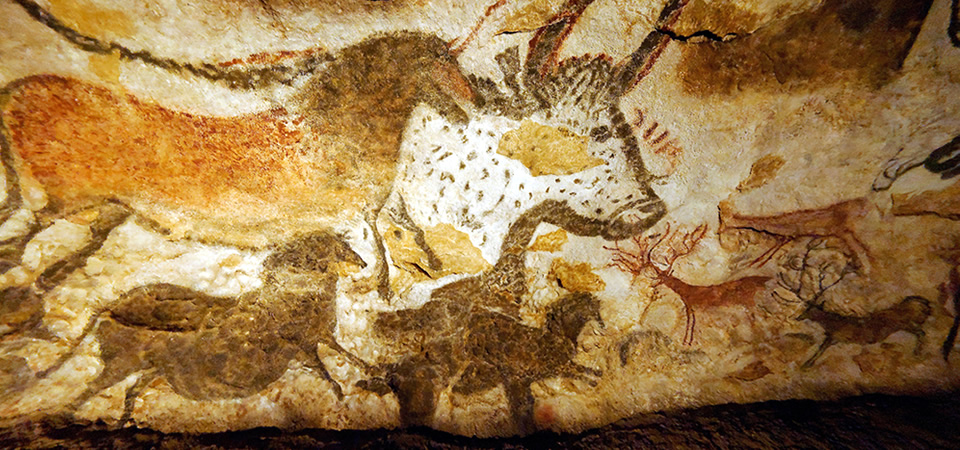
In an innermost room of the Lascaux cave, a hunter picked up a paint-loaded reed or hollow bone, drew in a breath, and gazed at an empty wall. In the next moment, using a sophisticated blowing technique, the artist lifted his airbrush to his lips and began to create. Thirty thousand years later, a professor in Iowa’s International Writing Program wants to remind us that we’re all still primal hunters. In the intimacy of a small classroom in the English-Philosophy Building, Shelley Berc and her husband, visual artist Alejandro Fogel, 95MFA teach, the lost skill of tracking down our own wild animals, the life-sustaining beasts of our dreams and imaginations.
Over an intensive four-week period, in a course called “Creativity Workshop: Writing, Drawing, and Storytelling as Personal Memoir,” Berc and Fogel investigate ways of breaking through barriers of rational thinking, of unlocking personal images and letting loose creative thinking.
Berc calls the class a hands-on workshop wherein students use creative writing, drawing, painting, collage, photography, and other art forms to explore the possibility of understanding the world through its images and its symbols. The goal is not to create a product, but to re-express those images in ways that are both collective and universal and also one’s own.
From her perspective as a university teacher, Berc recognized that the imaginative process was not being taught. After developing her ideas and teaching the creativity workshop for several years in Europe, she won support from the university in 1996 to begin teaching her methods at the UI.
“It’s a way for people from all kinds of disciplines to come together and make sometimes really exciting artistic discoveries, but also humanistic discoveries,” Berc says.
The workshop lures writers, painters, sculptors, and dancers interested in overcoming creative blocks, but Berc’s favorite class rosters have reflected a multitude of disciplines. Students from fields usually considered not so fanciful, such as education, science, and business, also enroll to rediscover the power of their imaginations. Even a few doctoral candidates can provide grateful testimonials to the magic of the workshop in getting them past that daunting first blank page to a finished thesis.
The syllabus for the course includes not one textbook, but Berc and Fogel do ask that her students have certain prerequisites. “Openness, the energy of a child, a sense of wonderment,” Berc says. “And leave the critical brain at home, the part that says, ‘yes, no, it’s not good enough, it’s better than.’ Critical judgment should stay at home, locked in a closet, hidden under the bed or in the cellar.”
Nobody in Berc’s workshop picks apart anyone else’s story or poem or drawing. Not a big believer in reading work in progress aloud to a large audience, Berc instituted the practice of having participants whisper their writing to a single listener, with the partners switching every time. From these quiet pairings, students develop close bonds with one another and start working as a team. When they finally perform before the full class toward the end of the course, they receive praise and support, expressions of simple joy from people who themselves feel the need to make something, to tell a story, to connect some dots.
If we don’t develop our urge to create, Berc says, we may well end up like the subject in our prehistoric ancestor’s cave wall painting, where a wounded bison lies in front of a hunter–and the hunter is dying.
“When creativity isn’t valued in society, destruction takes over,” Berc says. “We’re more complex than our consumer culture credits us for. We’re not here just to eat, to go out and buy.”
Berc and Fogel are determined to revive the hunter asleep inside their students. Introducing tools not normally used in university classrooms, they lead participants in meditation and visualization exercises, automatic drawing and writing, map making, and even playacting with puppets. Each semester, about 18 students begin every workshop session by lying down in the middle of the classroom floor for a body relaxation exercise–it’s the beginning of an adventure of discovery, a journey through defenses that prevent them from creating.
“The worst thing is the fear of creating,” Fogel says. “Anxiety about the empty page. We all have that beginner’s mind every time we have to face the start of another project.”
Fogel jolts students out of that fear when he holds up a sheet of paper and then instantly crumples it up and throws it away.
“I want to produce a kind of shock, to show them that this piece of paper that you think is so precious because it has your work on it, is not so great,” he says. “The impulse to create is infinitely more important than any product created. Once they realize that, it becomes much easier to start putting marks down on the white page.”
To calm the class down and to concentrate everyone’s attention on their interior sensibilities, Berc begins every workshop session with a series of relaxation and visualization exercises. The students focus their thoughts on their breathing and on relaxing muscle tensions. Berc then takes her listeners on a flight over the topography of their imaginations, as she recites archetypal stories about adventures, journeys, and myths, and encourages the students to “watch the images their bodies leave behind.” When someone happens to catch sight of an interesting image, that person rolls over onto her stomach to write or draw in a sketch pad. Soon more and more students have picked up their pencils.
“Automatic writing and drawing are ways of discovering the truth of the subconscious,” says Fogel. “And we try to create the idea that the students are not really doing the work–that the unusual images or words emerge automatically. So, the students can be free of guilt about what they make because they’re not rationally thinking about it. And that produces the most interesting pieces, because it gives them more freedom from self-censorship than they would have if they sat down to purposely write or draw using their rational consciousness.”
Lying on the floor changes the association with creating, according to Berc, taking students both literally and figuratively to another dimension.
“Getting back on the floor and playing with your crayons is good!” she says. “A lot of the creativity that we’re born with–it’s almost a birthright–is lost through experience, the necessities of survival, and education. If you watch children when they’re young learners, they like to do things on the floor, they like to draw on the floor, they like to sprawl out. Why? When you work that way, you are much less rigid. You’re playing! Play is how we learn. If we don’t have enough play, we can’t learn how to survive. And survival isn’t just physical. We as human beings can’t survive without dreams.”
From the relaxation and visualization exercises on the floor, participants move on to “show and tell” games, short interviews with one another, and playacting, all efforts to learn true stories about themselves and others. In finding out what stories they have to tell, participants have the express permission from Berc and Fogel to steal from each other, a concept Berc calls “appropriation.” If a participant finds somebody else’s image meaningful, he is free to appropriate it for the duration of the workshop in order to shape the stolen image into work that is truly his own.
“Our idea of stealing is mostly geared to get people to work in groups, to be able to think the same way the other person works,” Fogel says. “In the workshop, we talk a little about the collective unconscious, Carl Jung’s theory. We talk about how each of our unconsciousness is just a little part of the enormous universal unconsciousness. In a room, ideas from that unconscious are floating around. We see that in our workshop all the time. We see people working with the same images without looking at each other’s work. Certain groups have fish, for example. That’s why we say that the ideas within this room are the property of everyone.
Encouraged to freely appropriate ideas from each other, students feel liberated from the paralysis that can strike when they’re told to create something new.
“There’s nothing new anyway,” Berc says. “It’s all about how we reinterpret what’s already been done. From the Middle Ages up until the Renaissance, nobody worried about being original. Artists only painted about five subjects and they were all religious.”
With creativity tools learned from Berc and Fogel, students work on expressing their memoirs in the course. The teachers say that talking about personal histories is something anyone can do, and it’s a technique that builds a sense of safety and community in the class. But memories also contain many of the universal images that rattle our bones and blind us with beauty, and so they become useful strategies for originating and organizing creative work.
“Especially if you’re not an artist, that’s where you can find a lot of your creative juices,” Berc says.
The workshop culminates in participants sharing a visual autobiographical map presented on 12-foot rolls of butcher paper. Each student creates a three-dimensional representation of his or her writing, drawing, or performance, presenting a cartography of the individual’s discovery of the creative process.
“The basic notion of our workshop is a paradox,” says Fogel. “We are trying to teach people about process and not product and that’s what we do, but in the end, they all end up with a product!”
Students from The Creativity Workshop should be able to walk away from the class with a set of tools they can use for a lifetime of creative expression. But more importantly, Fogel and Berc say they want the students to take with them the wish to dream.
“We hope that, even if they don’t become artists, at least people come out of our workshops having gained confidence in their imaginative birthright or actually go on to develop it,” Berc says. “It’s very necessary to our survival to have the time to play, and to play imaginatively. We’re trying to remind people that we’re all creative beings. To deny the creative side of ourselves is like depriving ourselves of access to divine.”